
An SEO agency powering your growth.
90.88% of pages get zero organic traffic from Google (Ahrefs). Our job is to put your site in the other 9% — continuous optimization and content generation, not set-it-and-forget-it. Flat-rate pricing, month to month.
The three pillars of SEO that ranks.
Rankings come from doing three things well, in the right order. Skip one and the other two underperform.
Technical & On-Site SEO
Well-written content can't rank on a broken site. We fix speed, site architecture, crawlability, and structured data first — the foundation everything else compounds on.
- Site speed & Core Web Vitals
- Architecture, URLs & internal links
- Schema & structured data
- Mobile optimization
SEO Content Generation
Custom-written content mapped to what your customers actually search — not filler. Fresh, regularly updated pages that balance keyword targeting with being genuinely worth reading.
- Keyword & intent research
- Custom-written service & blog content
- Content refresh cycles
- Conversion rate optimization
Off-Site & Local SEO
Authority and proximity. Google Business Profile management, review generation, and citations that put you in the map pack — where local buyers actually click.
- Google Business Profile management
- Review generation strategy
- Local citations & directories
- Digital PR (add-on)
What do SEO services include?
SEO services include technical site optimization, keyword and content strategy, custom-written content, off-site authority building, and local search management — ongoing monthly work, not a one-time fix. Every Actuate program also includes keyword tracking, competitive monitoring, and conversion rate optimization, reported in a live dashboard.
You'll see all of it in a live dashboard, and we'll walk through the numbers together in a monthly strategy review — what moved, what didn't, and what we're changing next. It's the same program that grew a DTC brand's organic traffic 210% in eight months. And if an outdated site is what's holding rankings back, our website design team builds SEO-friendly sites that make our SEOs' lives easier.
- SEO strategy — the masterplan
- Technical SEO (metas, schemas, Open Graph)
- On-site SEO (structure, URLs, content optimization)
- Off-site SEO (GBP, review generation)
- SEO-driven custom-written content
- Keyword tracking via SEMRush
- Competitive insights & monitoring
- Conversion rate optimization (CRO)
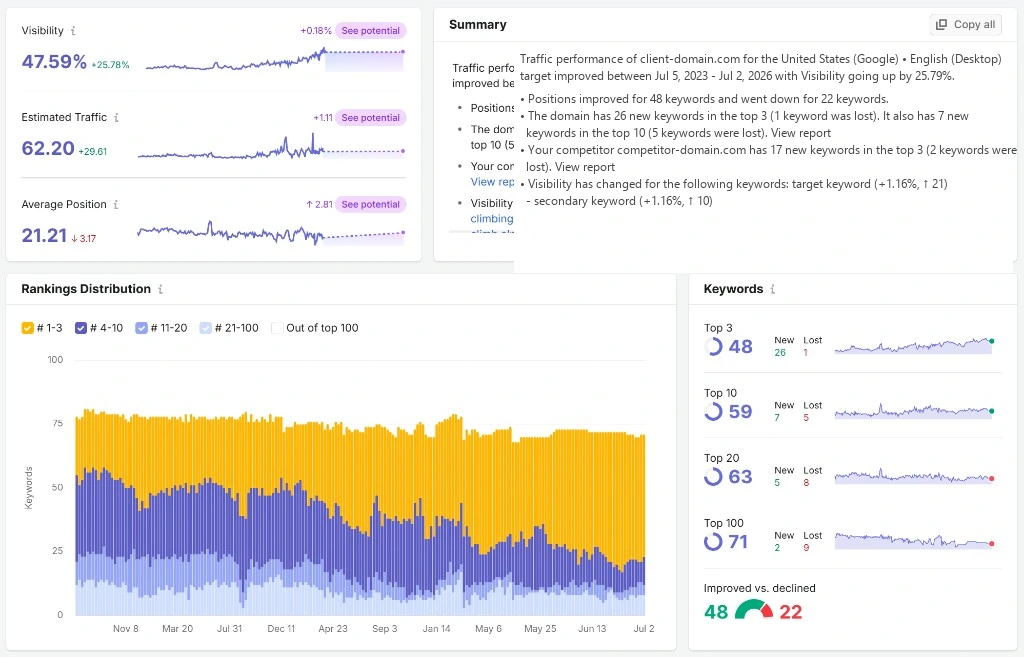
Client domain and keywords redacted · SEMrush position tracking
Rankings are the input. Revenue is the report.
A ranking report is the easiest deliverable in this industry to make look good — pick enough keywords and something always went up. We measure three layers instead, and the third one decides what we work on next.
Visibility
Tracked keyword positions plus Search Console impressions and queries — what your market actually searched, and where you appeared.
SEMRush position tracking · Google Search Console
That the work is reaching the right searches. Leading indicator — never the scoreboard.
Organic leads
Forms, chats, and calls from organic sessions, counted as GA4 key events and attributed to the landing page that earned them.
GA4 key events · CallTrackingMetrics · Upchat.io
Which pages rank and convert — and which rank and do nothing, which a ranking report hides.
Revenue
What those leads became once your team touched them: junk, qualified, booked, sold — and for how much.
your CRM · ecommerce revenue in GA4
Whether the program pays for itself — the number next quarter's content plan is built on.
What we do when the tracking is broken — which is most of the time.
On roughly every audit we run, at least one of these is true: calls aren't tracked, form submissions fire no event, or GA4 was configured once and never checked. We fix measurement in month one, before the content plan, because SEO work you can't attribute is indistinguishable from luck.
Tracked keyword set, Search Console queries, and current organic key events are recorded in month one. Without a baseline, every later number is a claim rather than a measurement.
Leads are attributed to the landing page, not to "organic / google". A page can rank and still produce nothing — that is a content problem, and it is invisible in a rankings report.
Your team marks the outcome and the value in the CRM. That judgment is the only signal that separates traffic from money, and no analytics tool can produce it.
Outcomes decide next quarter's work: which clusters get expanded, which pages get refreshed or consolidated, which keywords we stop paying attention to.
The limits, stated plainly: Google withholds keyword-level data in analytics, and Search Console keeps only 16 months of history — so we warehouse the monthly exports from day one rather than lose the baseline. Attribution is directional, not forensic: some buyers find you organically, then return through a branded search or an ad. We report the assist; we don't bill the same sale twice.
See what's holding your rankings back.
A real audit by a strategist — not an automated score out of 100. We'll send back the specific issues we'd fix first, in priority order, whether or not you hire us.
- Technical issues blocking indexing or speed
- The keywords you're close to winning — and the ones you're not
- Whether your conversions are being tracked at all
- What your competitors rank for that you don't
The data behind the reports — and who can check it.
SEO has no vendor-neutral certification that means much — which is exactly why the industry is full of unverifiable claims. What can be verified is the tooling a report is built from and the public record of an agency's work. Both are below.
What your reporting is actually built from
SEMRush — position tracking and the keyword set
Our primary platform, and the source of the tracked keyword list your reports are built on. As an SEMRush Agency Partner our listing, service scope, and client reviews are public — checkable by you, not just claimed on a badge.
Search Console and Bing Webmaster Tools — the search engines' own data
Impressions, queries, indexing, and crawl errors straight from the source. Third-party tools estimate; these two report. Where they disagree with a rank tracker, these win.
Screaming Frog, Ahrefs, and Moz — audits and authority
Full-site crawls for technical work, backlink and referring-domain data for off-site work. We use whichever tool answers the question at hand rather than defending one vendor's numbers.
And what a partner badge doesn't mean
A partner listing means our tooling and reviews are public. It does not mean our SEO will work on your site — no badge can promise that, and nobody can guarantee a ranking. So ask the two questions a badge can't answer: who specifically writes and ships the work, and what the last client in your industry actually got.
We'll answer both before you sign anything — and the engagement is month-to-month, so the answer stays testable. Roughly 99% of our clients stay without a contract requiring it; that number is ours to lose every month.
Two organic programs we can name.
Both are home services — the category where local SEO is hardest to fake, because the client can count the phone calls. Metrics are cited to the systems they came from, and both programs took longer than a quarter to get there.
Both run on the measurement described above — calls, chats, and forms attributed to the page that earned them. See all case studies.

SEO/GEO/AIO Flat-rate. Month to month. Scoped to you.
$1,299/month is the starting point for WordPress sites — not a one-size-fits-all price. Competitive keywords, larger sites, and heavier content programs cost more. Your proposal spells out exactly what your rate covers and why, and once quoted, it's flat for the scope we agreed. Digital PR and extra content (beyond the pages in the plan) run as add-ons — scoped separately.
- No setup fees
- No long-term contracts
- Monthly reporting
- Monthly strategy meetings
What GEO is, and why it's in your SEO plan.
Generative engine optimization is the work of getting your business named in the answer an AI assistant writes — ChatGPT, Google's AI answers, Copilot, Perplexity. It is not a separate product we upsell. It's three practices layered onto the same content and authority work, because the engines reward roughly the same things for roughly the same reasons.
Answer the question in the page
Generative answers are assembled from passages, not from whole pages. So the page has to contain a direct, self-contained answer to the question it targets — near the top, in plain language, without requiring the surrounding article for context.
Make the entity unambiguous
Models need to be certain who you are before they will name you: consistent business facts across your site, Google Business Profile, and third-party listings, plus schema that states the relationships between your organization, services, and locations.
Be cited where models look
AI answers lean on sources that other sources reference — industry publications, directories, review platforms, and original data. This is the same off-site work that earns rankings; the payoff is now double-counted.
The honest version
No agency can guarantee an AI citation, and anyone selling a "GEO package" with promised placements is selling something they don't control. Attribution is harder here too: assistants influence more than they refer, so part of the effect surfaces as branded search and direct visits rather than a line in a report.
What we will do is separate what we changed, what we measured, and what we're inferring — and publish our own research instead of repeating other people's. Search didn't shrink — it moved. See the 2026 benchmarks.
What clients say on Google.
Google reviews load when this section is on screen.Read reviews on Google
Straight answers about SEO services.
What SEO costs, how long it takes, and what we will — and won't — promise. Need leads before SEO compounds? Pair it with Google advertising.
Ask us anything SEO (search engine optimization) is the process of improving your website's content, structure, and authority so it ranks higher in search results. Higher rankings drive organic — non-paid — traffic: more qualified visitors, more leads, and more customers without paying per click.
Expect noticeable movement in 3–6 months. Highly competitive industries or keywords can take a year or more. We set realistic milestones during onboarding and report against them every month, so you always know where you stand.
Our SEO/GEO/AIO plans start at $1,299 per month for WordPress websites. The final rate depends on keyword competitiveness, site size, and content volume. Digital PR and extra content (beyond the pages in the plan) run as add-ons, scoped separately. Pricing is flat-rate and month-to-month — no long-term contract required.
They do different jobs. Google Ads buys immediate visibility that stops when the budget does. SEO compounds — it builds visibility and credibility that keeps working. Most of our clients run both: ads for leads this week, SEO for market share next year.
SEMRush is our primary platform — we're an SEMRush Agency Partner. We also work in Ahrefs, Moz, Screaming Frog, Google Search Console, and Bing Webmaster Tools, depending on what the job calls for.
No — and you should be wary of any agency that does. Google's algorithm isn't for sale. What we do commit to: agreed KPIs before launch, transparent monthly reporting, and a month-to-month engagement you can leave if the work isn't working.
What we've published on organic search.
Written by the strategists who do the work — not a content farm.


Local results need local signals.
Map packs, competitors, and search intent shift by metro — so keyword targeting and local-SEO work do too. Pick a market for how we run SEO there.
Not in one of these metros? Organic search doesn't require a local office — we run programs nationwide from Seattle, and the fundamentals travel. Get a free SEO audit.
Let Actuate Media be your competitive advantage.
Tell us about your business and your goals. We'll send back a free, no-obligation proposal — usually within two business days.